
Your First motorcycle creates three jobs before the first recreational ride: receive it without missing damage or documents, give it a secure legal place to stay, and learn its controls in a setting that does not punish hesitation. A checklist helps because excitement makes small omissions feel unimportant until a key, tire, insurance card, or garage rule becomes the reason the bike cannot be used.
At delivery, slow the moment down
Confirm the vehicle identification number against the paperwork before the seller or transporter leaves. Photograph the motorcycle from each side and capture the odometer, tires, controls, and any existing marks. Check that the promised keys, manuals, service records, spare parts, and accessories are present. If a document is missing, write it down with a specific follow-up rather than relying on memory.
Look underneath for fresh fluid, feel the tires for obvious softness, and verify that the steering unlocks. A motorcycle can arrive clean and still need mechanical attention. Delivery inspection is not a full safety inspection; it is a record of what arrived and an opportunity to flag immediate problems.
Set up storage before the bike needs it
Measure the route into the space, including gate width, ramp angle, turns, and the area needed to dismount. Make sure the motorcycle does not block a building exit, accessible route, hydrant, utility room, or another vehicle. Ask for written garage rules when the space is shared. Some operators specify where motorcycles may park or prohibit certain maintenance and battery-charging activities.
Security works in layers. Use the steering lock as designed, add a quality lock suited to the environment, consider an anchor where permitted, and keep the space well lit. A cover can reduce attention and weather exposure, but it must be secured so wind does not turn it into a sail. Do not trap moisture against a hot or wet motorcycle.
First motorcycle paperwork has a home
Create one folder—physical or digital—for the title or purchase record, registration, insurance, inspection, service receipts, tire dates, and transport documents. Photograph the keys and record identifying information separately from the motorcycle. Keep roadside and insurer phone numbers available without storing sensitive originals on the bike.
Calendar reminders are more reliable than memory for registration, inspection, policy renewal, and scheduled service. Read the owner’s manual maintenance table rather than following a generic internet interval. A used bike with uncertain history may need a baseline inspection even if the next mileage milestone appears far away.
Learn the cockpit while the engine is off
Identify the ignition, engine stop switch, clutch friction zone, front and rear brakes, signals, horn, high beam, fuel display or reserve arrangement, and any rider modes. Practice mounting, dismounting, and moving the motorcycle by hand on level ground. Learn how the side stand behaves and where the bike balances before adding engine noise and traffic.
Adjust mirrors and levers only within manufacturer guidance. An awkward reach can become a delayed braking input. If a control feels wrong or a warning light remains on, consult the manual or a qualified technician rather than normalizing the problem because the motorcycle is new to you.
Protective gear belongs on the checklist
Use a properly fitted certified helmet, abrasion-resistant riding apparel, gloves, and over-the-ankle footwear. Try the full set while seated on the motorcycle. A jacket that rides up, gloves that bunch at the lever, or boots that cannot fit under the shifter can distract a beginner. Visibility aids should not depend on a single reflective patch; positioning and lighting remain essential.
Carry only what the motorcycle can secure. Loose backpacks, dangling straps, and items placed on the seat can contact wheels or hot components. If you add luggage, follow weight and mounting limits and practice with it before taking a longer trip.
Choose a first practice environment deliberately
A training course is the strongest starting point because the exercises, space, and coaching are structured. Afterward, select a dry, daylight practice area where riding is permitted and traffic is minimal. Work on starts, stops, smooth clutch use, controlled turns, and scanning. End the session before fatigue changes technique.
Increase complexity one variable at a time. A familiar street in good weather comes before a congested bridge approach at night. Passenger riding, heavy luggage, and group rides add responsibilities and should wait until basic control feels routine.
Delivery may be safer than the inaugural ride
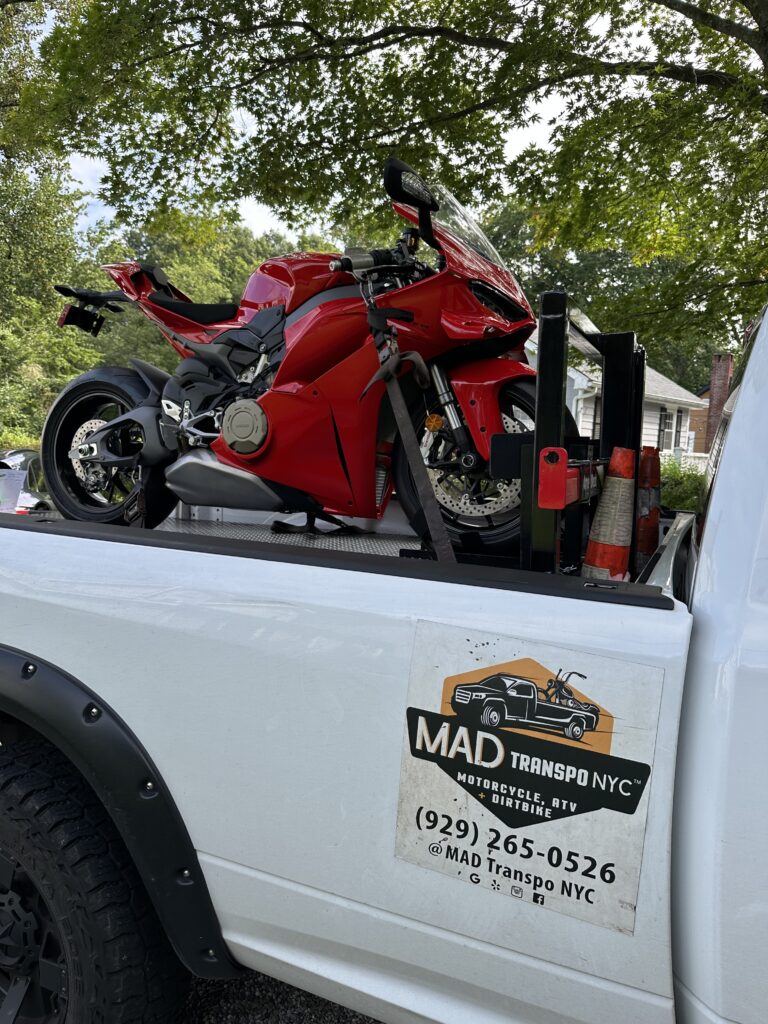
If insurance or registration is incomplete, the motorcycle is mechanically uncertain, weather is poor, or the route exceeds the rider’s current skill, arrange transport. MAD Transpo NYC describes motorcycle transportation and roadside assistance throughout the New York City metropolitan area. Tell the provider whether the bike starts, rolls, steers, and holds air, plus any low-clearance or access issue.
At the destination, inspect the bike before storing it and place the key and records in their planned locations. Separating delivery from the first ride removes deadline pressure and lets the owner begin with a proper mechanical and safety review.
The night-before check
- Weather and planned route reviewed.
- Tires, controls, lights, fluids, chain or belt, and fasteners checked according to the manual.
- Registration, insurance, license, and phone secured.
- Protective gear laid out and fitted.
- Fuel range understood.
- A trusted person knows the route and expected return.
This is not a substitute for maintenance or training. It is a final pause that catches simple problems while the motorcycle is still parked.
Create a baseline service record
For a used motorcycle, ask a qualified technician to establish what is known and unknown. The review may cover tires, brakes, fluids, drive system, battery and charging, controls, lights, leaks, suspension, steering, and outstanding maintenance. Record the date, mileage, findings, and next action. A seller’s recent-service claim is helpful only when it is specific and supported.
For a new motorcycle, read the break-in and first-service instructions. Do not substitute generic advice from another model. Note whether the warranty requires particular records or procedures. Store receipts and service notes where they can be found during a roadside call or future sale.
Practice the unglamorous movements
Many first-bike drops happen while parking, turning around, using a stand, or pushing on a slope. Practice choosing a level spot, looking where you intend to move, keeping hands clear of pinch points, and asking for help before the bike passes the point you can control. Learn how the steering lock and seat release work without rushing.
Do not attempt to lift a fallen motorcycle in traffic or when injured. Secure the scene and get assistance. In a safe training environment, an instructor can demonstrate an appropriate lifting technique for the rider and motorcycle. Knowing when not to lift is part of the skill.
Household members need a simple boundary
Explain that the motorcycle is not to be moved, sat on, started, or used as a storage shelf without the owner’s permission. Keep children away from a hot engine and unstable stands. Store keys securely. Clear boundaries reduce low-speed drops and burns more effectively than assuming everyone understands motorcycle-specific risks.
Review the plan after thirty days
At the end of the first month, revisit storage, security, gear fit, service needs, and training goals. Replace checklist items that proved irrelevant with observations from actual use. Ownership becomes safer when the system evolves rather than remaining a document completed once on delivery day.
If safe delivery is the remaining item on your first-bike checklist, contact MAD Transpo NYC with the pickup location, destination access, motorcycle condition, and receiving window.