
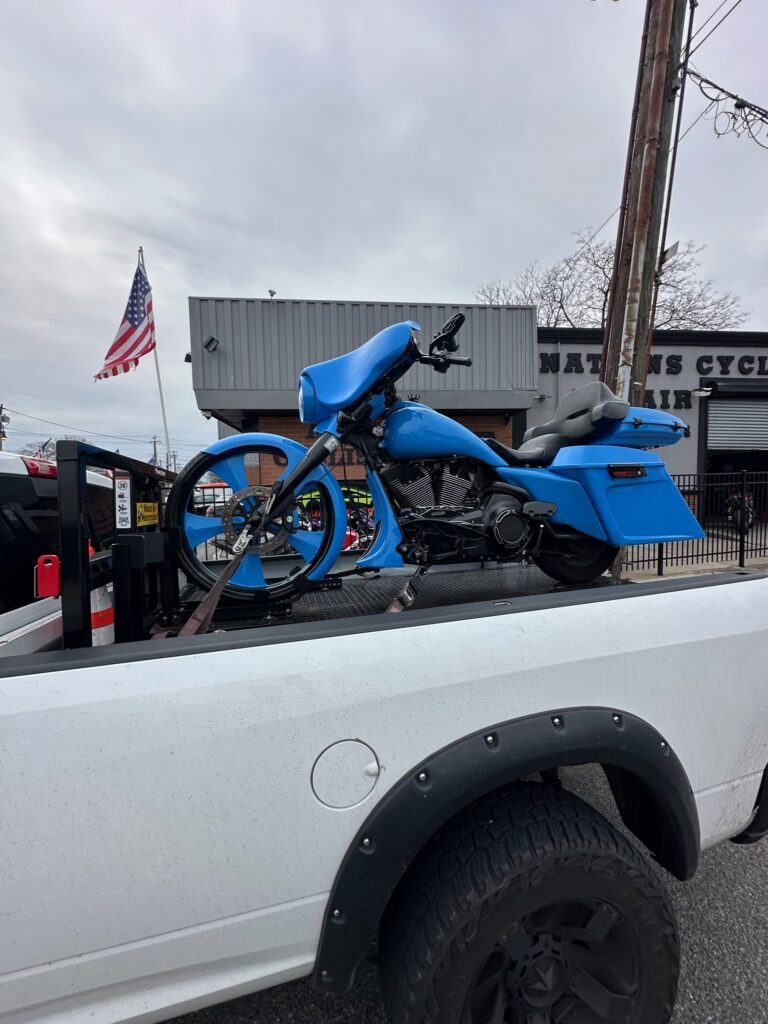
Call Motorcycle roadside assistance when continuing to ride would turn uncertainty into exposure: the motorcycle’s control, tire, temperature, electrical system, or structure is questionable; the rider cannot safely assess it; or the location makes troubleshooting dangerous. The decision should happen before a small symptom becomes a crash, a larger repair, or a stranded rider after dark.
Stop for changes in control
Unexpected steering resistance, wobble, brake change, clutch failure, throttle that does not return normally, a loose lever, or a wheel that feels misaligned deserves an immediate safe stop. Do not continue because the motorcycle still moves. Controls that are merely “different” can become unavailable during the next turn or stop.
After parking, inspect only from a safe position. Do not place hands near hot, pressurized, or moving parts. If the cause is not obvious and safely correctable under manufacturer guidance, arrange recovery.
Stop for tire and wheel warnings
A rapid pressure loss, visible puncture, sidewall damage, bent rim, broken spoke, severe vibration, or tire rubbing should end the ride. A motorcycle has little tolerance for uncertainty at either contact patch. Temporary repairs have limitations and should not be treated as permission to ignore structural damage.
When calling, report which wheel is affected and whether it turns. A bike that cannot roll may require different loading equipment. Tell the provider if the motorcycle is in a parking structure or another place with restricted truck access.
Heat, smoke, and fluid are not wait-and-see symptoms
Move away from traffic and switch off the motorcycle if warning lights, steam, smoke, strong fuel odor, or visible leakage suggest a serious problem. Do not open a hot radiator or coolant cap. Keep ignition sources away from fuel and call emergency services if there is fire or immediate danger.
Record the instrument warning and where the fluid appears, but do not crawl under the bike beside traffic. A photo from a safe angle can help explain the situation to the mechanic and recovery provider.
Electrical problems can return after a jump
A drained battery may be the symptom of a charging fault. If a jump start is followed by dim lights, warning indicators, rough operation, or another stall, do not depend on the motorcycle for the rest of the trip. Night riding with uncertain lighting and repeated roadside stops compounds the risk.
Describe whether the engine cranks, clicks, starts and dies, or has no electrical response. Avoid repeated attempts that drain the battery further or overheat a starter.
Call because of the location, even for a small problem
A minor issue in a private lot may be inspectable. The same issue on a bridge approach, blind curve, narrow shoulder, or high-speed roadway is not. Prioritize leaving the danger zone and follow instructions from police, tunnel staff, bridge personnel, or roadway operators. Private assistance may have to meet at an approved location.
Share direction of travel, nearest exit, lane or shoulder position, and landmarks. A map pin on the wrong carriageway can delay help significantly.
Call when the rider is the limiting factor
Injury, dizziness, heat stress, cold exposure, panic, exhaustion, or inadequate gear can make continuing unsafe even if the motorcycle is mechanically sound. Seek medical help when needed. Do not let concern about the motorcycle delay care.
A separate person may need to receive the bike. Arrange a legitimate contact and destination while the rider is safe. The transport provider should not be asked to leave the motorcycle unattended or bypass ownership requirements.
Motorcycle roadside assistance needs a destination
Choose a mechanic, dealership, home, or storage location that can accept the bike. Call ahead when possible. Provide hours, service entrance, and recipient. A shop name alone may route the truck to a showroom or locked entrance.
MAD Transpo NYC advertises motorcycle roadside assistance and transport to mechanics and dealerships across the New York City metropolitan area. Explain both the immediate symptom and whether the bike rolls, steers, and holds air.
Situations that belong with emergency services
Call 911 for injury, fire, collision danger, a vehicle blocking active traffic, hazardous leakage, threats, or another immediate public-safety issue. On controlled roads, use posted emergency systems as directed. Roadside assistance is not a replacement for police, fire, medical, or traffic control.
Once the scene is controlled, recovery can be coordinated with the responding authority. Ask where and when a private provider may access the motorcycle.
A simple decision rule
If you cannot confidently answer all three questions—Is the motorcycle controllable? Is the rider fit for the route? Is the location safe for the next step?—stop and seek appropriate help. Waiting in a protected place is usually less costly than turning a warning into damage or injury.
A dashboard warning deserves context
Not every indicator means the same thing, and symbols vary by motorcycle. Move to a safe place, consult the owner’s manual, and note whether the warning is steady or flashing and what the engine was doing. A normal reminder should not be confused with a critical oil, temperature, brake, or charging warning; uncertainty is a reason to stop, not to invent a meaning.
Photograph the display while parked and tell the technician whether the light appeared at startup, under acceleration, after rain, or with another symptom. Do not clear codes or disconnect the battery merely to make the warning disappear before diagnosis.
Repeated roadside episodes change the decision
If a motorcycle has already stalled, overheated, lost pressure, or required a jump during the same trip, a temporary recovery does not prove it is ready to continue. The second incident is evidence that the underlying problem persists. Arrange transport rather than extending the route one short segment at a time.
This is especially important late at night or before a bridge, tunnel, or highway section with limited stopping space. Choose a destination that can accept the bike and preserve notes about both episodes for the mechanic.
Fuel uncertainty is not always solved by adding fuel
If the motorcycle unexpectedly stops, confirm the fuel display or reserve procedure from the manual, but do not stand in traffic experimenting. A strong fuel smell, leak, or repeated stalling points away from a simple empty-tank explanation. Use approved fuel handling and get professional help when the cause is uncertain.
Lost keys can become a transport call
A missing ignition key, damaged key, or immobilizer problem may leave a mechanically healthy bike unable to move. Search safely and contact the owner or dealer about legitimate replacement steps. Tell roadside assistance that the steering may be locked and no key is available; that detail affects loading.
Weather exposure can escalate a wait
During extreme heat, cold, lightning, flooding, or poor air quality, the rider’s shelter may matter more than staying beside the motorcycle. Follow emergency guidance and tell dispatch if you relocate. Do not wait in a flood-prone underpass or beneath unstable roadside structures simply to keep the bike in sight.
After a roadside repair, reassess the whole route
A safe minor adjustment may restore normal operation, but the original destination and conditions still matter. Test only as directed in a protected setting, monitor the relevant system, and shorten the trip if appropriate. If confidence remains low, choose transport rather than using traffic as the test environment.
Prepare before phone coverage becomes weak
Save insurer, roadside, and emergency numbers offline. Know the motorcycle description and plate without opening a cloud file. In tunnels, remote park areas, or underground garages, note the nearest staffed point. Preparation reduces the amount of troubleshooting attempted simply because a call is difficult.
For a safe, non-emergency recovery plan, send your location, observed symptoms, movement condition, and destination to MAD Transpo NYC.