Most riders only see a few minutes of their motorcycle’s tow: the truck pulling up, the bike going onto the deck, and the truck driving away. But those few minutes decide whether your bike arrives in the same condition it left. A good motorcycle towing service treats loading and tie-down as the most important part of the job, not an afterthought.
This guide takes you inside the process. It explains how a motorcycle is typically loaded onto a flatbed, where straps should and should not go, and what you can watch for so you know your bike is being handled properly.
Why loading and tie-down matter more than the drive
Motorcycles are not built to be carried. They are tall, narrow, and balanced on two contact patches. On a moving truck, every brake, bump, and turn tries to shift the bike. If the bike is not secured correctly, it can lean, slide, or tip. Even a small shift can scratch paint, crack plastic, or bend a lever.
A careful motorcycle towing service focuses on three goals:
- Keep the bike upright and stable for the whole trip
- Hold it by strong, structural points rather than fragile parts
- Avoid contact between hardware and paint, plastic, or chrome
Step 1: The walkaround
Before anything moves, the driver should take a look at the bike. That usually means noting its condition, checking whether it rolls, and spotting anything loose, leaking, or damaged. This is also the moment to mention anything the driver cannot see, like a weak kickstand, an aftermarket part, or a bike that pulls to one side.
It is a good habit to take your own photos at this point too. A quick set of pictures from every side gives you a clear before record.
Step 2: Getting the bike onto the deck
On a flatbed, the deck tilts down to make a ramp to the ground. The bike is then rolled or winched up the ramp, depending on the setup and the bike’s condition. A rolling bike can often be guided up carefully. A non-running or damaged bike may need a winch or extra hands to control it on the way up.
The deck is usually brought back to level once the bike is on board, which makes tie-down easier and more stable.
What can make loading harder
- A locked front wheel or steering lock with no key
- Flat tires or a seized brake
- Very low ground clearance or long bodywork that could scrape on the ramp angle
- Tight spaces where the truck cannot line up straight
Step 3: The front wheel chock
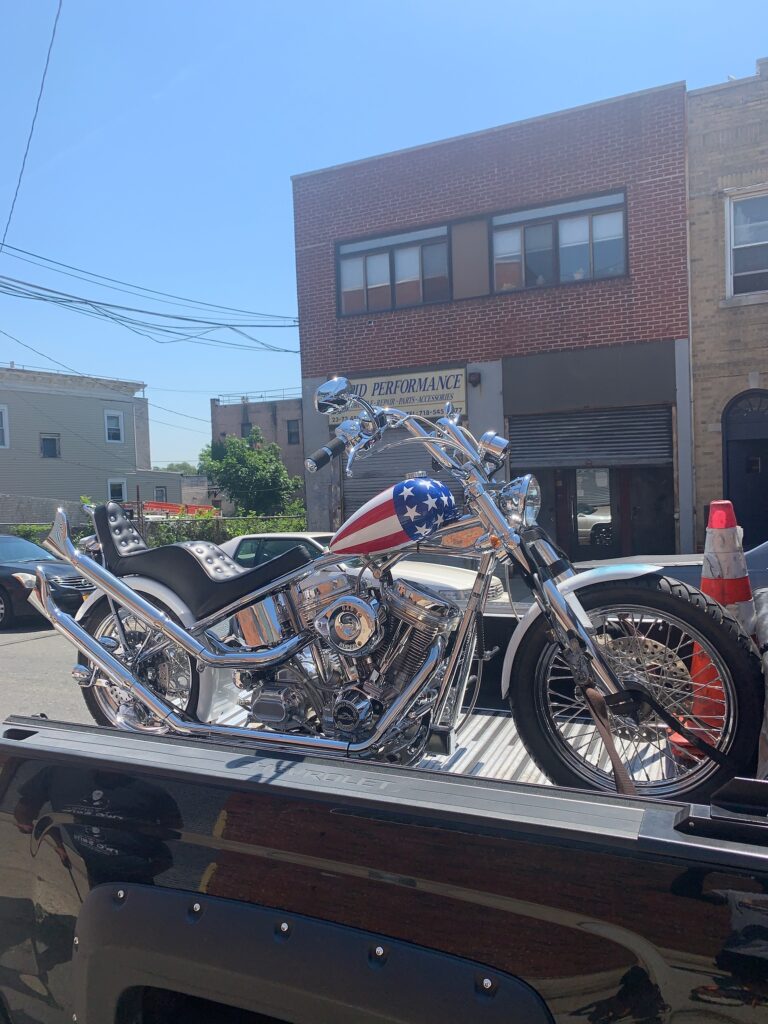
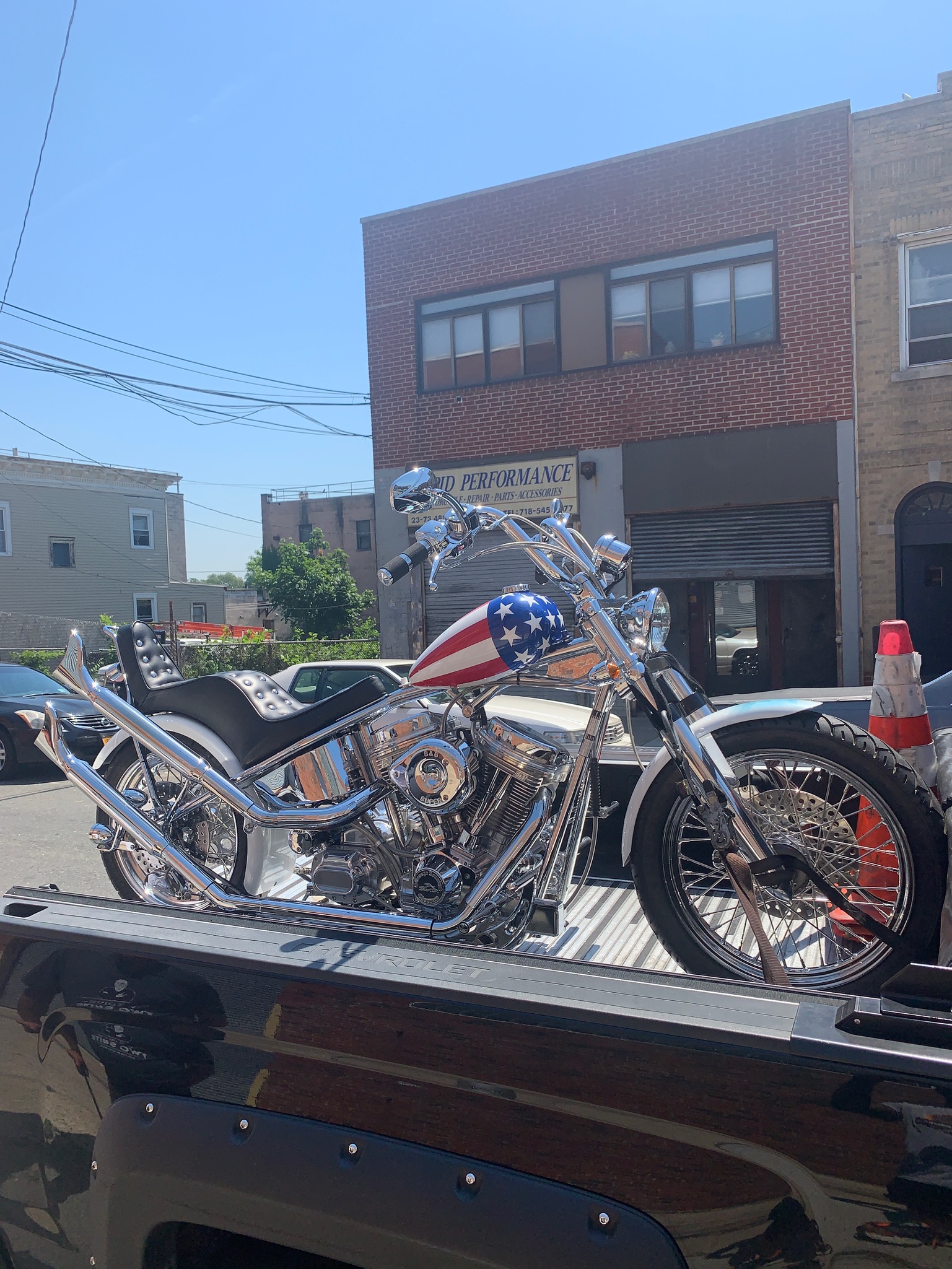
Once the bike is on the deck, the front wheel is usually rolled into a wheel chock. A chock is a cradle that holds the front tire in place and keeps it pointing straight. It stops the front of the bike from sliding side to side and gives the straps a stable base to work against.
MAD Transpo NYC uses a front wheel chock as part of its standard motorcycle setup.
Step 4: Soft ties at the front
Hooks and ratchet straps are strong, but they should not touch your bike directly at the front. Instead, a careful service loops soft ties around solid structural points first, then attaches the ratchet straps to those soft loops.
The triple tree, the clamp that holds the fork tubes at the top or bottom, is a common choice. It is strong and close to the bike’s center line. Handlebars can be used on some bikes, but bars on certain models are mounted in rubber or are not designed for that kind of load.
MAD Transpo NYC describes its motorcycle setup as soft-tie straps at the triple tree, a front wheel chock, and nothing chained near the fairings.
Step 5: Rear tie-downs
The rear of the bike also needs to be held in place so it does not swing during turns. Rear straps typically attach to solid frame points, the passenger peg mounts, or the subframe, depending on the bike. The goal is to keep the rear centered without pulling on fragile parts like turn signals, plastic tail sections, or exhaust tips.
Step 6: Getting the tension right
Strap tension is a balance. Too loose, and the bike can move. Too tight, and the suspension can be compressed so far that it bottoms out, putting stress on seals and components. A careful operator pulls the straps down evenly on both sides so the bike sits upright, compresses the front suspension only partially, and stays firm when pushed.
After the bike is strapped, a good driver will give it a firm shake to check that it moves as one with the truck.
What should never touch your bike
Whatever company you use, these are red flags:
- Chains on or near painted parts, fairings, or chrome. They scratch and dent easily.
- Ratchet hooks attached directly to bars, levers, or plastic. They can slip or crack parts.
- Straps across the gas tank or seat. They can leave marks and do little to hold the bike stable.
- A bike resting on its kickstand during transport. The stand is not designed to take road forces and can fold or break.
Special bikes, special attention
Some motorcycles need extra care during loading and tie-down:
- Touring and bagger bikes are heavy and wide, with lots of bodywork that limits strap points.
- Sport bikes have full fairings and low ground clearance.
- Trikes and Can-Am three-wheelers need more deck width and different tie-down points.
- Vintage and classic bikes may have fragile parts and original finishes that are hard to replace.
- Dirt bikes and ATVs may be muddy, light, or used for off-road events with unique pickup spots.
If your bike falls into one of these groups, say so when you book so the driver can plan.
What you can do to help
You do not need to be a tow expert to make loading easier. A few simple steps help:
- Have the key ready and remove disc locks and chains.
- Take loose items out of saddlebags and remove a tank bag or phone mount.
- Mention any damage, leaks, or quirks before loading starts.
- Stand clear while the bike goes up the ramp.
- Take photos once the bike is strapped down.
Open deck or covered: what changes
Most local motorcycle tows happen on an open flatbed deck, where the steps above apply directly. Some owners of high-value or classic bikes prefer enclosed transport, where the bike rides inside a covered trailer or box. Inside an enclosed unit, the same principles hold: a chock or cradle for the front wheel, soft ties at strong points, and even tension. The main difference is protection from weather and road debris during the trip.
If you want enclosed transport, ask when you book whether it is available for your date and route, since options can vary.
Questions to ask before your bike is loaded
You are allowed to ask how your bike will be handled. A professional motorcycle towing service should be comfortable answering questions like these:
- Will the bike ride on a flatbed with a wheel chock?
- Where will the straps attach at the front and rear?
- Do you use soft ties between the hooks and the bike?
- How do you handle a bike that does not roll?
Clear, confident answers are a good sign that your bike is in experienced hands.
Unloading: the same care in reverse
At the destination, the process runs backward. Straps come off evenly, the bike rolls back out of the chock, and it is guided down the ramp and set on its stand on firm, level ground. Walk around the bike before the driver leaves and compare it with your earlier photos.
Frequently asked questions
Where should tow straps go on a motorcycle?
At the front, soft ties around strong points like the triple tree, with ratchet straps hooked to the soft ties. At the rear, solid frame or subframe points. Straps should not sit on paint, plastic, or the gas tank.
Is a wheel chock necessary when towing a motorcycle?
A chock holds the front tire straight and stable and gives the straps a solid base. It is a common part of a careful motorcycle towing setup.
Can a towing service damage my motorcycle’s suspension?
Over-tightened straps can compress the suspension too far. A careful operator uses even tension that holds the bike firmly without bottoming out the forks.
How does MAD Transpo NYC secure motorcycles?
MAD Transpo NYC uses a flatbed with soft-tie straps at the triple tree, a front wheel chock, and nothing chained near the fairings.
Choose a motorcycle towing service that loads it right
Your bike deserves the same care on the truck as it gets in your garage. Call MAD Transpo NYC 24/7 at 929-265-0526, request service through the MAD Transpo contact page, or browse all motorcycle towing and transport services.